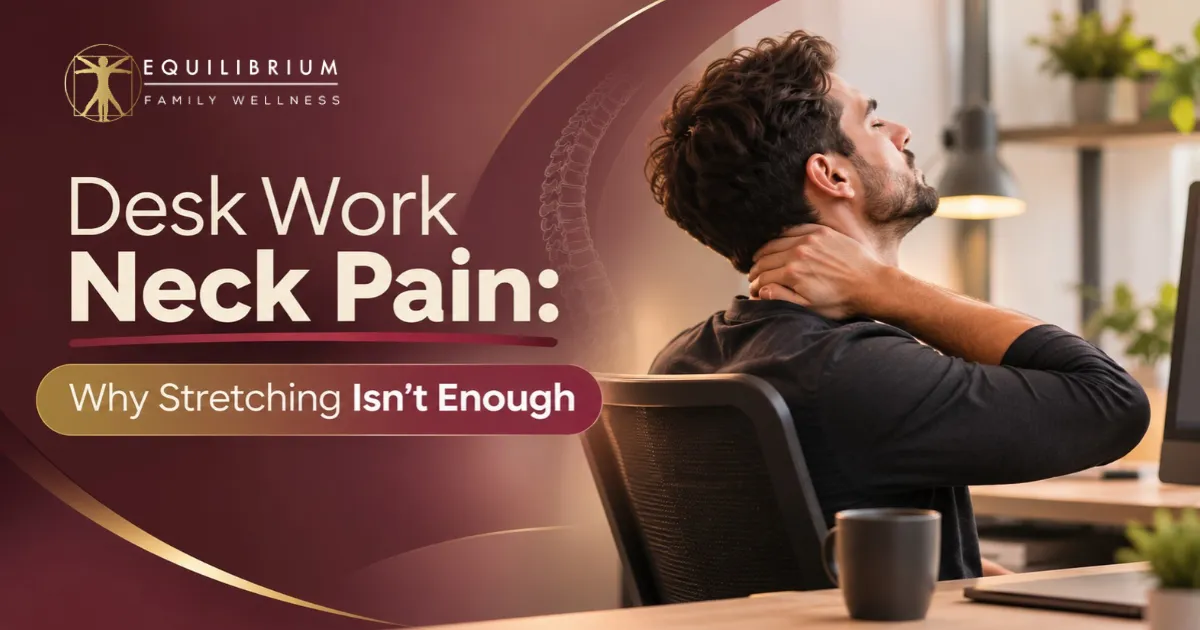
You finish a long day at the computer and the ache is already there. It starts at the base of your skull, creeps down into your shoulders, and by 3pm, turning your head to check your blind spot feels stiff and reluctant. You stretch it out, and it brings relief for ten minutes. You’ve bought a decent ergonomic chair, maybe even an expensive lumbar cushion. Yet, tomorrow, the cycle repeats.
If that sounds familiar, you are not alone. Desk work neck pain is one of the most common complaints we see at Equilibrium Family and Wellness. The good news is that it is rarely a sign of something serious. The better news is that the research is now very clear about what actually helps to manage it and why your current routine might not be cutting it.
This article will walk you through the common causes of office worker neck pain, what the evidence says about posture, and the practical steps you can take today to break the cycle. No vague promises. Just what the clinical guidelines and peer-reviewed research currently show.
What causes neck pain from desk work?
Neck pain from desk work is not usually caused by a single “bad posture.” It is often the result of three factors stacking on top of each other:
– sustained forward head position,
– prolonged static loading, and
– a lack of muscular endurance in the deep neck flexors.
When you sit at a desk, your head drifts forward. Your neck extensors and upper trapezius have to work harder to hold your head up. Over hours, this sustained low-level contraction can lead to trigger point development and referred pain into the shoulders and skull.
The “5kg head” analogy is useful here. When your head is balanced directly over your spine, the load on your cervical joints is minimal. For every inch your head moves forward, the effective load on your neck muscles and joints increases significantly.
But forward head posture alone doesn’t tell the whole story. A 2023 systematic review in the Journal of Orthopaedic & Sports Physical Therapy found that exercise interventions, specifically strength and endurance training for the neck and shoulder, can reduce the risk of developing neck pain in office workers. The review did not find that ergonomic changes alone were enough to prevent pain. That is an important distinction. Your chair matters, but your neck’s capacity matters more.
Why stretching isn’t enough to manage desk work pain
Stretching feels good, but it doesn’t build the endurance required to hold your head up for eight hours. This is where many people go wrong. They stretch their neck, book a massage, feel better for a few days, and then return to the same desk setup with the same weak neck muscles. The pain comes back because the underlying capacity issue was never addressed.
Exercise is the strongest lever you have. A randomised controlled trial on office workers with chronic neck pain found that combining ergonomic workstation interventions with deep neck flexor exercise produced statistically significant improvements in neck disability and forward head posture.
The exercise component was not optional; it was the driver of the change. Cervical stability training added to standard treatment modalities has also been shown to improve outcomes in forward head posture with chronic neck pain.
What does this look like in practice? It is not complicated. It is consistent. Deep neck flexor training, think gentle chin nods while lying on your back, builds endurance in the muscles that support your cervical spine. Scapular retraction exercises strengthen the mid-back so your shoulders are not constantly pulled forward.
These are the exercises we prescribe most often at our Brisbane clinic, and they are the ones patients tend to skip because they feel too simple. In practice, the patients who do them daily for six weeks are often the ones who see the most improvement.
What are the best exercises for desk work neck pain?
The most effective exercises for desk work neck pain are chin tucks and scapular retractions, because they target the deep neck flexors and mid-back muscles that switch off during prolonged sitting.
A chin tuck is simple: sit or stand tall, look straight ahead, and gently draw your chin straight back towards your spine, creating a “double chin.” Hold for 2–3 seconds, relax, and repeat 10 times. This reactivates the small muscles at the front of your neck that support your head.
Scapular retractions involve squeezing your shoulder blades together and down, holding for 5 seconds, and repeating 10–15 times. This strengthens the mid-back so your shoulders aren’t constantly dragged forward by tight chest muscles.
The key is frequency, not duration. Two sets of 10 chin tucks, performed twice a day, are more effective than a single long session once a week. These exercises are not glamorous, but they are the ones that build the capacity your neck needs to tolerate desk work.
How often should you take a break from sitting at a desk?
You should take a short movement break every 30 to 45 minutes, not because sitting is inherently harmful, but because your neck tissues need frequent changes in load to stay healthy.
A perfect chair does not cancel out eight hours of stillness. Your intervertebral discs rely on movement to circulate fluid, and your muscles respond to variety in position. Set a timer. Stand up. Roll your shoulders. Do ten gentle chin nods. Walk to fill your water bottle. These micro-breaks are not a productivity killer; they are a tissue-loading strategy.
Research on sedentary behaviour is consistent: the longer you sit without interruption, the more your neck and shoulder muscles adapt to a shortened, loaded position.
Can manual therapy or chiropractic care help?
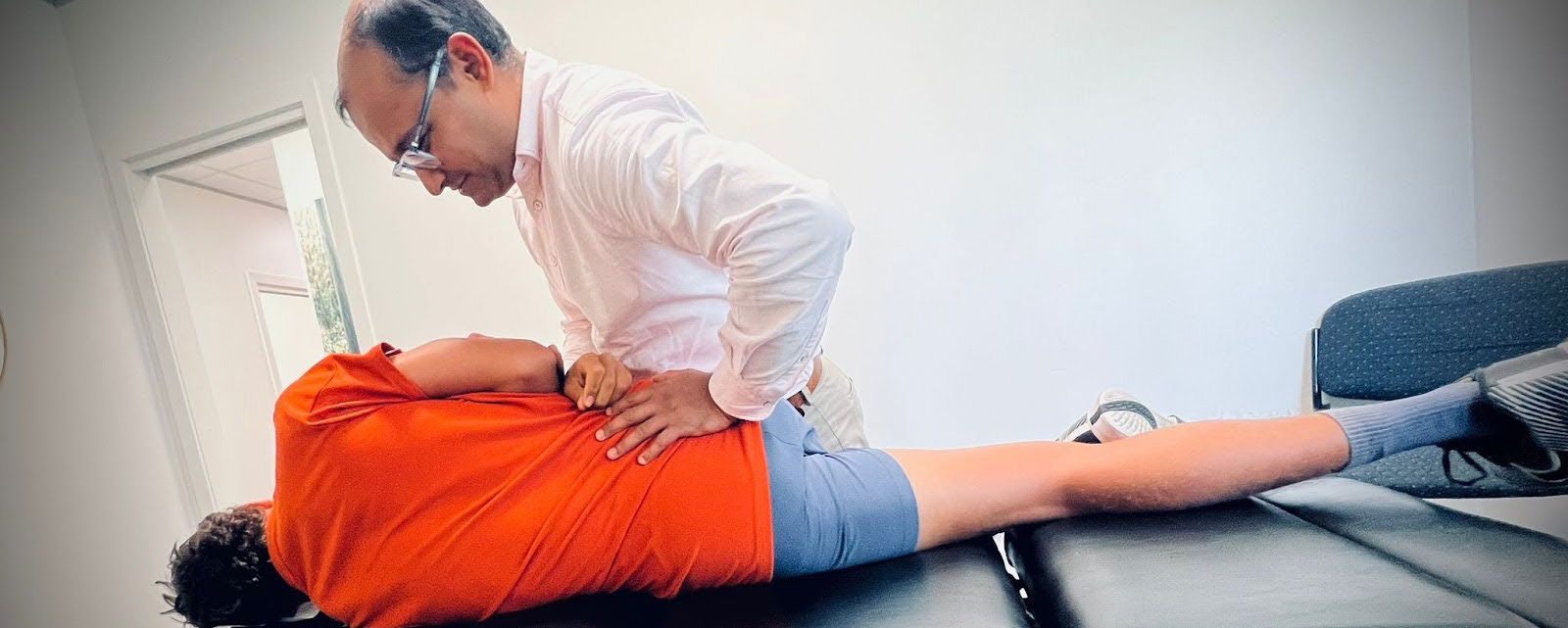
Manual therapy, including chiropractic adjustment, may form part of a broader management approach for short-term symptom relief. A 2024 systematic review on spinal manipulative therapy for non-specific neck pain found very low certainty evidence for reducing pain and improving disability. That does not mean it is useless. It means it should not be positioned as a standalone solution.
If you are in acute pain and cannot move your neck, a short course of manual therapy may help you get comfortable enough to start the exercise that actually addresses the issue. But if you are relying on adjustments alone to manage a desk-work problem, you may be managing the symptoms without fully assessing the contributing factors.
At Equilibrium Family and Wellness, we do not treat desk-work neck pain as a structural problem that needs to be “put back in place.” We view it as a capacity and function issue. Chiropractic care fits into that plan as a short-term tool within a broader rehabilitation approach focused on movement and function.
What can I do to prevent neck pain when sitting at a desk?
Prevention comes down to two things:
breaking up static posture and setting up your workstation so your body is not fighting gravity all day.
Mayo Clinic’s ergonomic guidance is a sensible starting point: chair height set so your feet rest flat on the floor, your spine supported, your monitor positioned to avoid straining, and your mouse and keyboard within easy reach.
If you work on a laptop without an external monitor, you are already fighting a losing battle. Laptop neck, sometimes called tech neck, happens because the screen is too low, forcing you to look down for hours. A laptop stand and an external keyboard are highly recommended if you use a laptop as your primary workstation.
How do I stop my neck from hurting when working on the computer?
You can reduce the likelihood of pain by changing the load on your neck before the pain starts, not after. Adjust your monitor height so the top third of the screen is at eye level. Keep your keyboard close enough that your elbows stay at roughly 90 degrees. And accept that your neck is not designed to hold one position for eight hours, no matter how good your posture is in that position.
A common assumption is that “good posture” means sitting rigidly upright with your shoulders pinned back. That is partially true, but it is not the whole picture. Your best posture is your next posture. The research on forward head posture and neck disability does not support the idea that there is one perfect sitting position. What it does support is that reduced muscular endurance and prolonged static loading are significant contributors to pain. So the goal is not to sit perfectly. The goal is to move often and to build enough neck and shoulder capacity that your tissues can tolerate the demands of desk work.
This is where a thorough assessment matters. Not because you need a diagnosis for something sinister, but because you need to know which specific muscles are underperforming and which workstation habits are contributing to the problem.
A generic ergonomic handout may not identify whether your deep neck flexors are the weak link or whether your thoracic spine is stiff and driving the compensation. A clinical assessment can help clarify this.
Frequently Asked Questions
Take a short movement break every 30 to 45 minutes. You do not need to leave your desk for long, standing up, rolling your shoulders, and doing a few gentle neck nods is enough to interrupt the static load. The frequency matters more than the duration.
Posture correctors can provide a temporary reminder to sit up, but they do not build the muscular endurance that helps prevent pain. The evidence supports exercise and workstation changes, not passive bracing. If you rely on a posture corrector without doing the strengthening work, the pain may return when you take it off.
Many people see meaningful improvement in forward head posture and neck disability after six to eight weeks of consistent daily exercise combined with ergonomic changes. The key word is consistent. Twice-a-week exercises may not be enough. Daily, short sessions are often more effective than occasional long ones.
A chiropractor can help manage the symptoms of tech neck and guide you through the exercise and ergonomic changes that address contributing factors. Management often involves a combination of better workstation setup, regular movement, and targeted strengthening, rather than manual therapy alone.
It can contribute to discomfort if you use it for more than an hour or two a day. A laptop without a stand forces your head into a downward gaze position, which increases the load on your cervical spine. A laptop stand and external keyboard are highly recommended if you use a laptop as your primary workstation.
Consider seeing a chiropractor or physiotherapist if your neck pain has lasted more than two weeks, is interfering with your sleep or work, or is accompanied by headaches, dizziness, or arm tingling. If you have experienced trauma or have a history of serious spinal conditions, seek medical assessment first.
If you have been managing desk-work neck pain on your own and it is not shifting, the next step is a thorough assessment. At Equilibrium Family and Wellness, we will look at your neck, your workstation, and your daily movement patterns, not just the spot that hurts. We will discuss what factors may be contributing to your pain and how you can manage it moving forward.
Book an assessment with Dr. Richard Kashmiri at our Brisbane clinic. Together, we will build a plan that fits your workday, not the other way around.
Visit Us
At Equilibrium Family and Wellness, Brisbane
Sources Used
1. Teichert F, Karner V, Döding R, et al. Effectiveness of Exercise Interventions for Preventing Neck Pain: A Systematic Review With Meta-analysis of Randomized Controlled Trials. *Journal of Orthopaedic & Sports Physical Therapy*. 2023;53(10):594–609. https://www.jospt.org/doi/10.2519/jospt.2023.12063
2. Benefits and harms of Spinal Manipulative Therapy for treating recent and persistent nonspecific neck pain: a systematic review with meta-analysis. *Research.vu.nl*. 2024.
3. Effects of ergonomic workstation interventions and deep neck flexors’ exercise on neck muscle performance, forward head posture, and neck disability. *ScienceDirect*. 2026.
4. Mayo Clinic. Office ergonomics: Your how-to guide. 2023. https://www.mayoclinic.org/healthy-lifestyle/adult-health/in-depth/office-ergonomics/art-20046169
5. Cochrane Review. Ergonomic interventions for preventing work-related musculoskeletal disorders of the upper limb and neck among office workers. 2023.