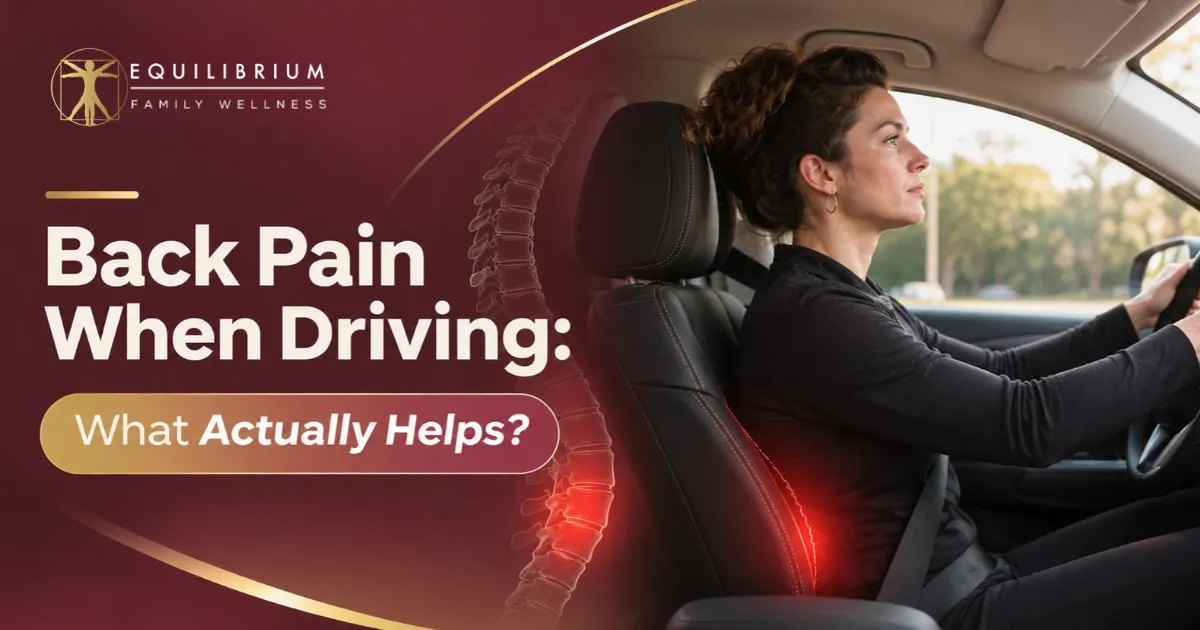
You merge onto the M1, settle into your seat, and the familiar ache starts to creep in. By the time you hit your exit, your lower back feels stiff, tight, and exhausted. You shift your weight from side to side, trying to find a comfortable position, but the car seat seems designed to work against you. You get out, stretch, and it eases until the next drive.
If this is a daily reality, you are not alone. Back pain from driving is one of the most common complaints we hear at Equilibrium Family and Wellness, particularly for commuters, tradespeople, and anyone navigating Brisbane’s sprawling road network. The good news is that the discomfort is rarely a sign of serious structural damage. The better news is that the research gives us a clear understanding of why it happens and what you can do about it.
This article will explain what the evidence actually says about driving and lower back pain, how to set up your car to support your spine, and the practical, AHPRA-compliant steps you can take to manage the ache whether you are driving to work or heading down the coast for the weekend.
Why does driving cause lower back pain?
Driving is a unique physical challenge for your lower back because it combines two risk factors: prolonged static sitting and whole-body vibration. A 2021 systematic review and meta-analysis found that prolonged driving time is a significant risk factor for low back pain, with an odds ratio of 2.03 compared with non-drivers . For context, prolonged sitting generally carries an odds ratio of 1.42, meaning driving is a substantially higher-risk activity for your spine .
The reason comes down to biomechanics. When you sit, the pressure inside your intervertebral discs increases, particularly in the lower back. Unlike your desk chair, a car seat is subjected to engine vibration, road texture, and suspension movement. This whole-body vibration is transmitted through the seat into your spine, and the muscles supporting your lower back must work continuously to stabilise the area. Over a long drive, this sustained low-level contraction leads to muscular fatigue, stiffness, and the deep, dull ache that is so characteristic of driving-related back pain.
The data on professional drivers makes this clear. A 2024 systematic review and meta-analysis of 19 studies involving 7,723 professional drivers found a high prevalence of low back pain (53% in the past 12 months) and identified uncomfortable seating, improper driving posture, and lack of back support as significant risk factors . While you may not drive for a living, the same mechanical principles apply whether you are a courier, a sales rep, or a parent doing the school run.
Does driving posture actually cause back pain? What the evidence says
You have probably been told to sit up straight or adjust your seat to 90 degrees to prevent back pain. Here is where the evidence gets interesting and where many clinics overclaim. A systematic review by Tinitali and colleagues at Monash University, published in Human Factors, investigated whether occupational driving posture actually causes low back pain . The authors found that while four studies identified an association, the measurement tools used lacked validity. Their conclusion was striking: although a relationship may exist, the specific driving postures associated with low back pain and the strength of this relationship have not been confirmed .
In plain terms: there is no single correct driving posture that has been proven to prevent back pain. The research does not support the idea that if you sit at precisely 100 degrees or 110 degrees, your back will be fine. What the evidence does support is that the total load on your spine matters and that prolonged, uninterrupted sitting in any position is a problem.
This does not mean posture is irrelevant. It means the goal is not a rigid, perfect posture. The goal is movement variability and reducing the cumulative time your spine spends in a loaded, static position. In practice, we see far more benefit from teaching patients how to break up sitting and build back endurance than from chasing a specific seat angle. If you have been told that your posture is the sole cause of your pain, that is an oversimplification.
How to set up your car seat to support your lower back?
While there is no magically perfect posture, a sensible seat setup can reduce unnecessary strain and make your drive more comfortable. Mayo Clinic’s ergonomic guidance for seated work translates well to driving: feet flat on the floor or pedals, knees at roughly hip height, and the seat back supporting the natural curve of your spine .
Position your seat so you can comfortably reach the pedals without fully straightening your legs (you want a slight bend in the knee). Your hips should be slightly higher than your knees, which tilts your pelvis into a more neutral position and reduces the load on your lower back. The seat back should recline slightly, around 100 to 110 degrees, rather than being bolt upright. If your car has a lumbar support adjustment, use it to fill the gap between your lower back and the seat. If it does not, a rolled-up towel or a small lumbar cushion can provide the same support.
Adjust your mirrors so you do not have to crane your neck or twist your upper body to see behind you. This reduces unnecessary rotation through your thoracic spine. And if your steering wheel is adjustable, bring it closer to you rather than reaching forward (this keeps your shoulders relaxed and your upper back supported against the seat).
Do lumbar supports and seat cushions help?
Lumbar supports and seat cushions can be useful adjuncts, but they are not a cure. The evidence for them is modest but positive. A double-blind randomised controlled trial on occupational drivers with chronic low back pain found that a gel seat cushion may be effective in relieving pain compared with a standard foam cushion . The study measured pain intensity and disability scores, and while both groups improved, the gel cushion group showed significantly greater reductions in pain .
The takeaway is reasonable: a supportive cushion can reduce pressure and improve comfort during long drives, particularly if your car seat is old or lacks adjustable lumbar support. But a cushion will not fix a weak back, and it will not replace the need to move. Think of it as a tool that makes the driving experience less demanding on your spine, not as a treatment for the underlying issue.
How often should you stop on a long drive?
Queensland road safety guidance recommends stopping for at least 15 minutes every two hours to manage fatigue . From a spinal health perspective, this is a sensible baseline, but some people, particularly those with existing lower back pain, may benefit from more frequent breaks. Some clinical commentary suggests stopping every 30 to 60 minutes for those with lower back problems, although this is not a firmly established research standard .
The specific interval matters less than the principle: your spine needs regular changes in position. When you stop, do not just sit in the driver’s seat and check your phone. Get out. Walk around. Do a few gentle back extensions. Roll your shoulders. Five minutes of walking and movement is far more beneficial for your lower back than five minutes of rest in the same seated position.
If you are planning a long trip (Brisbane to the Sunshine Coast, or further), build the breaks into your schedule. Treat them as part of the journey, not an inconvenience. Your spine will thank you, and you will arrive less stiff and sore.
Exercises for back pain from driving
Exercise is the most reliable way to build the capacity your lower back needs to tolerate driving. A 2024 systematic review on physical activity and exercise interventions in occupational drivers found that low back and neck pain improved following stretching movements, isometric exercises, and exercise education compared with control groups . The exercises do not need to be complicated. They need to be consistent.
Before you drive, try a few gentle movements to warm up your spine. Cat-cow stretches on the floor or in your seat can mobilise the lower back. A standing hip flexor stretch (placing one foot forward and gently shifting your weight forward) can relieve the tightness that builds up when your hips are flexed for long periods. Glute bridges, performed lying on your back at home, activate the gluteal muscles that support your lower back and counteract the effects of prolonged sitting.
After a long drive, do not collapse onto the couch. Take five minutes to move. A short walk, a few gentle spinal rotations, and some deep breathing can help restore movement and reduce stiffness. These small habits, repeated consistently, are what build resilience over time.
Can a chiropractor help with back pain from driving?
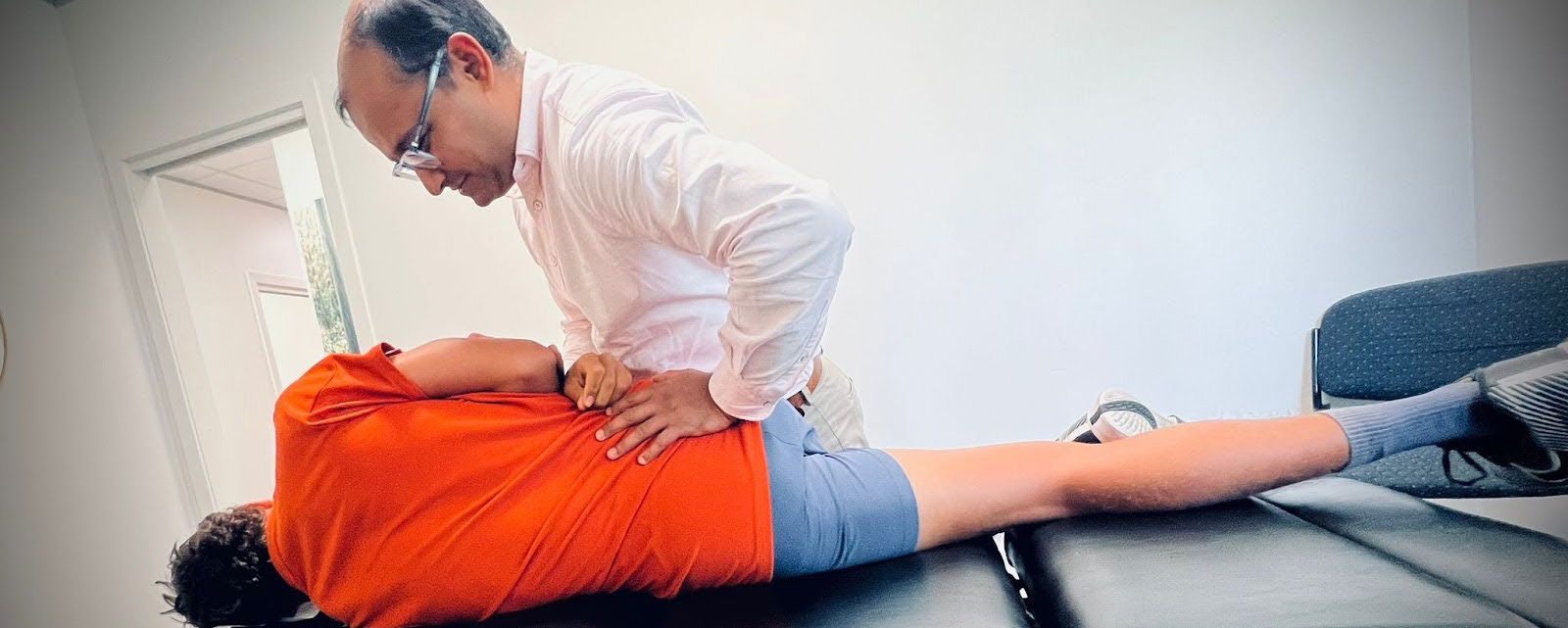
Chiropractic care may form part of a broader management approach for driving-related back pain, particularly for short-term symptom relief. Manual therapy, including spinal adjustment, can help reduce muscle tension and improve mobility when your back feels locked up after a long drive. However, it is important to be clear: manual therapy alone does not address the underlying capacity and loading issues that contribute to driving-related pain.
At Equilibrium Family and Wellness, we do not treat driving-related back pain as a structural problem that needs to be put back in place. We view it as a load and capacity issue. Your back hurts because the demands of driving (prolonged sitting, vibration, and limited movement) may exceed the tolerance of your spinal tissues. Care often focuses on supporting spinal mobility and function, reducing unnecessary strain through seat setup and driving habits, and building tolerance through targeted exercise.
If you have been relying on adjustments alone to manage your back pain, and it keeps returning after every long drive, that may be a sign that the contributing factors have not been fully assessed. It is not a sign that you need more adjustments. It may be a sign that you need a different plan (one that includes movement, strengthening, and sensible driving habits).
When should you see a professional?
Most driving-related back pain is muscular and mechanical, and it improves with movement, ergonomic changes, and time. However, there are situations where you should seek a professional assessment. If your pain persists for more than two weeks, is severe enough to interfere with your sleep or daily activities, or is accompanied by numbness, tingling, or weakness in your legs, you should see a healthcare professional. If you have experienced trauma, such as a car accident, or have a history of serious spinal conditions, seek medical assessment first.
A thorough assessment can help identify which specific factors are contributing to your pain whether it is a lack of spinal mobility, weak gluteal or core muscles, or a seat setup that is placing unnecessary strain on your lower back. A generic handout will not tell you which muscles are underperforming or which habits are feeding the problem. A clinical assessment can.
Frequently Asked Questions
Driving combines prolonged static sitting with whole-body vibration from the road and engine. This increases pressure on your intervertebral discs and fatigues the muscles supporting your lower back. The longer you sit without a break, the more your spine adapts to a loaded, static position, leading to stiffness and ache.
There is no single proven perfect posture. The research has not confirmed a specific seat angle that prevents pain. A sensible setup (feet flat, knees slightly bent, seat reclined to about 100 to 110 degrees, and lumbar support in the natural curve of your back) can reduce strain, but movement and regular breaks matter more than finding the perfect angle.
They can help as an adjunct. A randomised controlled trial found that a gel seat cushion may reduce chronic low back pain in occupational drivers compared with a foam cushion. A cushion can improve comfort and reduce pressure during long drives, but it does not replace the need to move and build back strength.
Queensland road safety guidance recommends stopping for at least 15 minutes every two hours. For spinal comfort, some people may benefit from stopping every 30 to 60 minutes, particularly if they already have back pain. The key is to get out, walk, and move not just sit in the same position.
Driving is generally more demanding on your lower back because it adds whole-body vibration to prolonged sitting. A meta-analysis found that driving time carries a higher risk for low back pain than general prolonged sitting. The vibration and the limited ability to change position make driving a more significant load on your spine.
Chiropractic care may help with short-term symptom relief and improved mobility, and it may form part of a broader management plan. It is most effective when combined with exercise, sensible driving habits, and seat setup. Manual therapy alone is not a standalone solution for driving-related back pain.
If you have been managing driving-related back pain on your own and it is not shifting, the next step is a thorough assessment. At Equilibrium Family and Wellness, we will look at your spine, your movement patterns, and your driving habits not just the spot that hurts. We will discuss what factors may be contributing to your pain and how you can manage it moving forward.
Book an assessment with Dr. Richard Kashmiri at our Brisbane clinic. We will build a plan that fits your life, your commute, and your body.
Visit Us
At Equilibrium Family and Wellness, Brisbane
Sources Used
1 – Tinitali S, Bowles KA, Keating JL, Haines T. Sitting Posture During Occupational Driving Causes Low Back Pain; Evidence-Based Position or Dogma? A Systematic Review. Human Factors. 2021;63(1):111-123.
Direct Link: https://pubmed.ncbi.nlm.nih.gov/31513435/
2 – Baradaran Mahdavi S, Riahi R, Vahdatpour B, Kelishadi R. Association between sedentary behavior and low back pain; A systematic review and meta-analysis. Health Promotion Perspectives. 2021;11(4):393-410.
Direct Link: https://pubmed.ncbi.nlm.nih.gov/35079583/
3 – Lee JW, Lim YH, Won YH, Kim DH. Effect of gel seat cushion on chronic low back pain in occupational drivers: A double-blind randomized controlled trial. Medicine (Baltimore). 2018;97(40):e12598.
Direct Link: https://pubmed.ncbi.nlm.nih.gov/30290629/
4 – Zeb A, Verbrugghe J, Neven A, Burtin C, Janssens L, Meus T, Timmermans A. Effects of Physical Activity and Exercise Interventions on Health Outcomes in Occupational Drivers: A Systematic Review. Workplace Health & Safety. 2025;73(2):95-108.
Direct Link: https://pubmed.ncbi.nlm.nih.gov/39707845/
5 – Prevalence of and risk factors for low back pain among professional drivers: a systematic review and meta-analysis. Journal of Orthopaedic Surgery and Research. 2024.
Direct Link: https://www.scienceopen.com/document?vid=8e21e939-6d6f-465e-9e31-221d9ad3fcb5